Sunday, 29 December 2013

So far

Christmas and soon the New Year. I've had meetings in the Stewartry, Nithsdale and Wigtownshire with various people and groups. The best is just having a hingin ear as you go through your life though, listening to folk talk. Since I've had my head adjusted to this task, every time I enter into any conversation at all ideas jump out.

I'm going to approach it as an encyclopaedia, same as the McTaggart original, part as an homage, partly because it gives me a chance to indulge flights of fancy, very much like he did. I'm including definitions of words, phrases, idioms, and looking at places, people, themes.

Recent entries I've drafted have been under A: Anthony Hopkins bench; Away with the Fairies, under H: Hollow; Hingin Ee, under F: Feisty; Funerals.

It's not going to be a work of ethnology though it will include what people have said to me. The object is to show how rich I feel Galloway is, it's history and legacy, its people. The object is mostly to entertain. Me. You, also. And maybe those that come after.


Sunday, 15 December 2013

The Yule Boys

 
In the 19th century, groups of boys in Galloway would reenact a pageant or play for pennies at Christmas. The play took the form of two knights competing for the hand of a lady. 
They lads would argue, fight, then one would throw the other on his back, and take his prize into the moonlight.

The Boys of Yule, Thornhill December 2013

In a frosty road, the three of them,
cans ablaze like corselets:
the blood red heraldry of Tennents 
stark in pub light. It's an old play:
'a pantomime', she sighs,
and walks off before the words
or blows. 'I'm bored',she says,
'and moving on'.

Tuesday, 10 December 2013

Sectarian Fairies

In the old stories the fairies were a mixed bag. Some worked well with humans, responded well to favours and kindnesses. When the Knight of Myrton Sir Godfrey McCulloch received a visit from the King of the Fairies complaining that a sewer he was having built was causing major subsidence in the fairy kingdom he immediately diverted it. This was a good move because the King of the Fairies turned up at Godfrey’s execution in Edinburgh and spirited him away just before the axe.


The Castle at Myrton
However many other sources show the fairies’ dark side, and even that they mirrored human prejudices.  The beautiful fairy girl of Cairnywellan Head near Port Logan, for instance, was a rose complexioned 12 year old who could be seen dancing and singing wildly when fugitives of the Irish rebellion of 1798 were found in the Rhinns and summarily shot or hung by the militia. She disappeared for 50 years but couldn’t contain her glee when the Potato Famine broke out and was soon out in the hills, again, dancing to celebrate the mounting body count.


The Church at Borgue
 

The story of the fairy boy of Borgue can be found in the records of the Kirk Session there. This boy would disappear for days or weeks on end, saying he had been with his ‘ people’. His grandfather sought help from a priest who banished the fairies. Thereafter the boy was shunned in the community, not because he’s been away with the fairies but because he’d got the help of a catholic. 
 
Trust Galloway to have Scotland's sectarian fairies!

Sunday, 1 December 2013

Theo and the Siller Gun


The Siller Guns of Kirkcudbright and Dumfries were trophies presented by King James V1 of Scotland to try and encourage skill and marksmanship using the new technology of musketry, at ‘Wappenshaws’. The idea, as ever,  was to have the locals able to defend themselves properly against the English when they attacked. The Dumfries Siller Gun was presented at a banquet by the King himself to the Trades of Dumfries in Queensberry Square, not that it was called that then, on 3rd August 1617.

"And may this day, whate'er befa',
The King's birthday, our Waponshaw
Be hailed wi' joy by great and sma',
And through the land
May Concord, Liberty and Law
Gae hand in hand."
 
From 'The Siller Gun' a poem of 1780 by Dumfries poet John Mayne

 The Kirkcudbright gun is a model of an early firearm called a hagbut, and has the date 1587, and the initials T Mc for Thomas MacLellan, Provost of Kirkcudbright. It is the oldest surviving sporting trophy in Britain
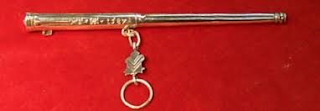
The Siller Gun of Kirkcudbright
.
The Dumfries gun was originally a miniature cannon mounted on a wheeled carriage, but in the early 19th century it was vandalised and remade by the silversmith David Gray  as a flintlock musket.
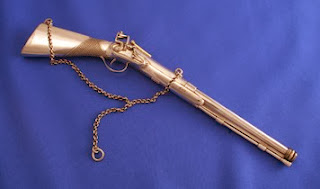
The Dumfries Siller Gun
 The Kirkudbright gun was older than the Dumfries one, but the contest for the Siller Gun in Dumfries is the one still regularly held, annually on or before the town’s Guid Neighbours Celebrations in June. The shoot was held at Kingholm in the old days, but for health and safety reasons moved to the gun club in the old aerodrome at Heathall. Competing either as individuals or as teams, the participants are often from the gun club itself or from various of the cadet forces, or the TA. The competition is intense, and the punch bowl which is awarded these days is a much coveted prize.

 In 2004, an ex-Chef well known around Dumfries, let’s call him Theo, having heard some talk of the contest in a pub, decided for a laugh to enter the siller gun with his mate, an ex-cabinet maker. It would be fair to say that the pair at that time had drifted from life’s mainstream and were full-time ageing hippies and  herbalists.  Having signed up when under the influence, and never  fired a gun in his life, Theo sought advice from his drinking cronies, some of whom had past military experience. “Breathe the bullet out” intoned the artist Hugh MacIntyre, mysteriously, “breathe it to the target.”  
 
Having completely disregarded or forgotten any advice, the pair spent the morning of the competition relaxing in their usual fashion then reeled up to shoot, among the last of more than three hundred competitors. “We were like Butch Cassidy and the Sundance Kid” said Theo later,
 “……..was blazing away in the booth next door and giggling like a madman, his cartridges kept falling onto my back, burning me”. Later on in the Hole in the Wa, a bemused Theo was sought out by one of the contest officials and told he’d scored ten perfect bulls-eyes, the best pattern since 1932 and had, much to his own and everyone else’s astonishment, romped the siller gun.


Sunday, 24 November 2013

Some Journeys

Crossmichael and New Galloway in the last two days. The Mickle is an old place, no less than 16 different ancient sites, forts and stone circles, are scattered round about. It looks old, too. The Church tower is 17th century but the site is more ancient than that. The village was rain swept and deserted. Like all these communities- I know, I live in one- they flare episodically into life but not that afternoon. 

Sir Robert Gordon who donated the bell in the Church Tower in the 1620s was one of the very first to obtain a charter to establish a colony of emigrants in Nova Scotia and thus begin Scotland's most consistently successful export to date, its own people. He and his son called the colony Galloway.

Crossmichael Church
There wasn't a soul in the Thistle Inn, until a couple from Blackpool arrived with their soulful spaniel. The last time I was in Crossmichael I was at the makar Willie Neill's funeral. Willie lived in a house adjoining the pub then later at another at the entrance to the village. He wrote in all the languages of Scotland, and was a terrific poet who, while not neglected in Scotland, didn't get accorded the status he deserved, the status he would probably have been given if he'd lived and worked elswhere.

Oscar and his Novel
Later at New Galloway, two buses missed and in the pitch dark, the Cross Keys Inn was packed, but everyone was from Cirencester apart from Oscar the dog, who owns his own book and piano and is from London.  It was a very big shooting party. Someone made the usual joke about hunting peasants. As they chattered. a weather beaten and worldly old man was scooping their fifty pound notes into a huge wad and I was reminded of Wille;s poem, The Marksman'.

I never saw him waste a single shot.
He wouldn’t fire unless he knew a kill,
Marksmanship guaranteed to fill the pot.
In memory I see him standing still
over the autumn moor. The swollen bags
of bowed-and-scraped-to gentry on a shoot,
wounding or blowing driven game to rags
or wasting cartridges without a hit
he sneered at, although sometimes paid to beat
their fostered game-birds on an autumn day.
‘There goes some London glutton’s annual treat….
and mostly killed by accident,’ he’d say.

Monday, 18 November 2013

Anthony Hopkins' Bench

 There are always rumours about celebrities having secret hideaways in Dumfries and Galloway. You'll be on one of these wee buses that circle the region relentlessly and some auld heid will jerk a nicotined thumb in the direction of a farm track and say something like 'yon Claudia Schiffer lives doon there'. It's a type of wishful thinking, I suppose, as well as a kind of pride in our insular and highly remote landscape, as though folk with all the world to choose from couldn't see past sitting in the drizzle at the top of Auchengibbert Hill when they weren't partying in Monte Carlo or Cannes. Maybe it's a folk memory of past glories, as well. After all when the area was a frontier, strategically important for centuries saints, sinners and soldiers did indeed stride the hills and glens. Everybody who was anybody from Agricola to Walter Scott.

Of course some A listers do live here. Joanna Lumley has a house in Tynron, Alex Kapranos does yoga in Moniaive, but then he's Scottish so that maybe doesn't count. And for everyone who does or has lived here there are plenty who have visited and hated the place. Didn't Britt Ekland, while filming The Wickerman, describe Newton Stewart as "the most dismal place in creation... one of the bleakest places I've been to in my life. Gloom and misery oozed out of the furniture."? Scarlett Johansson's feelings about being filmed in the moors round Wanlockhead in the middle of November pretending to be an alien harvesting hitchikers body parts are not recorded, but might be imagined.

Britt watching misery ooze from some furniture in Newton Stewart
Nevertheless some parts of the region attract fleeting visits from famous actors. One bench in particular in Douglas Hall near Sandyhills seems to be a magnet. A local was sitting on it when Brian Cox came ashore to join him on a break from filming 'Master of Ballantrae'. Another spotted Anthony Hopkins sitting on it, while holidaying in the area. Since then it's become known as the Anthony Hopkins bench and is a celebrity in itself.

The Anthony Hopkins Bench, Douglas Hall

Monday, 11 November 2013

The Landscape and Drink

I'm not claiming that in Dumfries and Galloway more drink is taken than in any other part of Scotland because in truth we are a nation that likes it's drink and our region just forms part of the great liquid heritage that is Scotland's history. However, as befits a frontier area,  we've done more than our bit. After all wasn't it at the Mull of Galloway that the last Pict with the secret of heather ale jumped into the sea rather than give the secret to the Romans? And what resulted from that? Drinking heather ale the Roman Legions would surely have been able to gub the Goths and the Vandals and all these other tribes over the Danube and perhaps we would all still be Romans, eating quail and rubbing our chins with pumice stones. Would that be good? Let me have another pint and think about it.

Carting booze around the region especially without paying duty was a popular and life threatening pastime for many years, and the proliferation of unlicensed drinking establishments gave a ready market. When Burns was an exciseman he visited Penpont which now doesn't even have a single pub but then had 9. He was beaten up for his snooping, quite rightly. In 1716 there were no less than 91 brewers in Dumfries. An early 19th century street plan of Dumfries shows more than 30 pubs or premises selling booze in Queensberry St alone.

Though the number of pubs declined the regions love affair with alcohol continued. Even after the Defence of the Realm Act in 1915 when pub opening hours were restricted to stop munitions workers falling steaming in the cordite, folk found a way round it. England's more relaxed licensing laws, at least until the 1970s, meant that people in some parts of the region were well placed to slip across the border for that vital last half hour's boozing. And not in small numbers. The Gretna munitionettes, there in huge numbers to save the nation during World War One, took to the train to Carlisle for a drink on a Friday or Saturday night. Trouble was the train arrived 5 minutes before closing time.  Sometimes the  train drivers were bribed to leave early but the barmen of Bousted's Bar in Carlisle knew to start    pouring and lining up a thousand whiskies on the bar before all these thirsty women arrived.

Where the workers boarded the train at Eastriggs
Others were prepared to risk their lives. After the giant Solway viaduct was shut to rail traffic, a guardhouse and gates had to be constructed to stop folk running the mile and a half across the Firth to more liberal drinking hours. People dying for a drink.

Although the pubs are fewer the thirst remains. Of course alcohol abuse is a terrible curse and drain on the NHS but human beings and drink are involved in a historical romance which continues to this day. Last night in Thornhill we were drinking our way through some of the gantry in the historic Farmers Arms, and swapping some drinking anecdotes but most were either litigious or not very savoury.
 My favourite story involves a visitor to Dumfries who was staying at the house of a resident and who set off on his own one October evening to explore. The next morning when he surfaced he told a story of the pub he ended the night in. He couldn't recall the name he said but there was a horse on the sign, there was a folk band, a beautiful girl, a roaring fire and he'd won £30 worth of tokens all of which he'd spent on drink and his new friend. He couldn't wait to go back and meet her. Of course, he couldn't find it because no such pub existed. Was it drink conflating three separate pubs together? Or was it a supernatural experience? Or was he just raving drunk? The friend and resident, from whom I gathered this tale, said he had persisted stubbornly in this delusion, even sending in an envelope a small silver fruit machine token he'd found at the bottom of his pocket. Needless to say it didn't fit any of the fruit machines his friend could find in the town.